Site-Specific Learning for Wireless Networks via Digital Twins
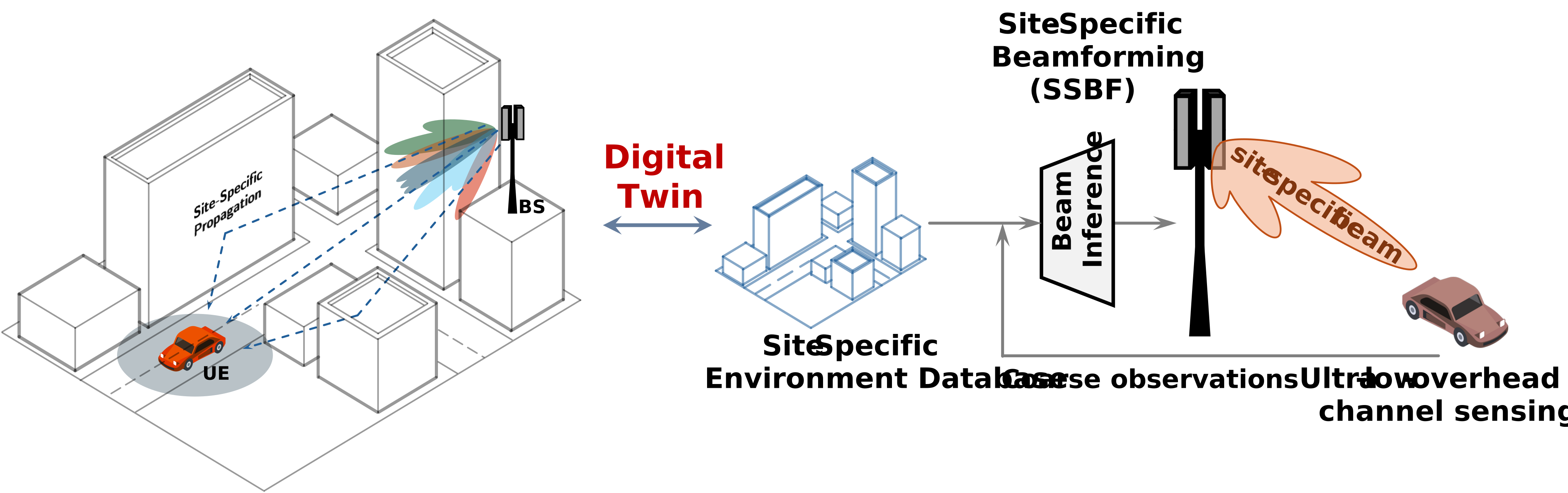
This research explores the integration of digital twins with machine learning to enable site-specific optimization in wireless networks. By leveraging high-fidelity virtual representations of physical spaces, we develop efficient learning frameworks that significantly improve communication and sensing performance. Unlike conventional machine learning approaches that rely on generalized datasets or statistical channel models for broad applicability, our models exploit the precise spatial and electromagnetic characteristics of a given environment. By prioritizing local accuracy over generic solutions, these digital twin-driven, site-specific models generate highly tailored, robust, and efficient network configurations, bridging the gap between theoretical models and real-world deployment.
Wireless Digital Twins
-
Fidelity Where it Matters: Site-Specific Nonuniform Refinement for Wireless Digital Twins
arXiv preprint arXiv:2605.08772, .
Site-Specific Beamforming
-
Generative Site-Specific Beamforming for Next-Generation Spatial Intelligence
IEEE Communications Magazine, . -
Beam-Brainstorm: A Generative Site-Specific Beamforming Approach
arXiv preprint arXiv:2601.02219, . -
Generative Site-Specific Beamforming via Information-Maximizing Codebook
arXiv preprint arXiv:2602.12552, . -
Fast Beam-Brainstorm: Few-Step Generative Site-Specific Beamforming with Flexible Probing
arXiv preprint arXiv:2603.17622, . -
Bridging Standardized Codebook and Site-Specific Beamforming: A Unified Limited-Feedback Framework
arXiv preprint arXiv:2604.14524, . -
Beyond Type-II: Site-Specific Subspace Inference for Efficient CSI Feedback
The 2nd Workshop of AI4NextG: AI and ML for Next-Generation Wireless at ICML, . -
SiFo: Wireless Foundation Model for Low-Overhead Site-Specific CSI Feedback
arXiv preprint arXiv:2605.16141, . -
Generative Site-Specific Beamforming for UPAs via Decoupled Channel Sensing
arXiv preprint arXiv:2606.22522, . -
Site-Specific Learning for Low-Overhead Multi-User MIMO Beamforming
arXiv preprint arXiv:2607.10746, .